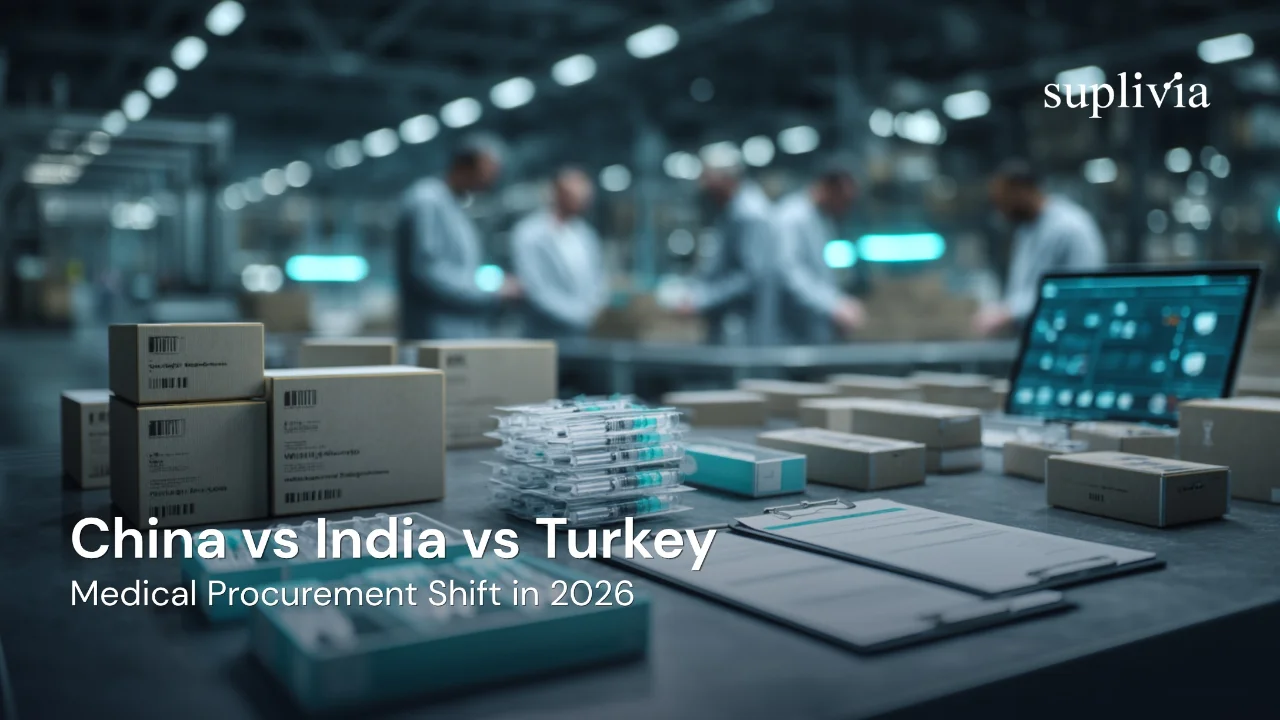
China vs India vs Turkey medical procurement shift in 2026 is redefining how buyers structure global sourcing strategies. Procurement teams are no longer relying on single-country supply bases, especially for medical consumables and mid-complexity devices. The shift is driven by cost volatility, regulatory tightening in Europe, and geopolitical risk exposure.
Global sourcing rebalancing in medical procurement
China remains the dominant manufacturing base for medical devices and consumables, but its share of new procurement inquiries is gradually declining in favor of India and Turkey. Buyers are actively re-evaluating total landed cost, certification reliability, and lead time stability.
India is gaining traction in single-use devices, diagnostic consumables, and pharmaceutical-adjacent medical supplies due to cost efficiency and expanding regulatory alignment with international standards. Turkey is strengthening its position as a nearshore hub for Europe, benefiting from shorter logistics routes and faster customs clearance into EU markets.
China continues to lead in scale and production depth, particularly in high-volume consumables and OEM manufacturing. However, procurement teams are increasingly segmenting sourcing strategies instead of relying on a single-country model.
Shift Index (2026)
New sourcing inquiries distribution across major supplier regions (relative procurement interest)
Why procurement is shifting away from single-country dependency
The main driver is risk redistribution. Buyers are responding to recurring supply chain disruptions experienced over the last five years, including shipping delays, raw material fluctuations, and regulatory bottlenecks in cross-border certification validation.
Regulatory pressure in Europe is also influencing decisions. Under tighter MDR enforcement expectations, procurement teams are prioritizing suppliers with stronger documentation control and audit readiness rather than purely cost-based selection.
Cost is no longer the only deciding factor. Total procurement risk now includes compliance exposure, supplier audit failure probability, and logistics predictability.
KEY TAKEAWAY
Medical procurement in 2026 is no longer country-driven. It is risk-structured, with China, India, and Turkey used in parallel rather than as substitutes.
China vs India vs Turkey: comparative sourcing dynamics
China remains the most mature ecosystem with unmatched production scale and component availability. However, buyers are segmenting China-based sourcing toward high-volume, cost-sensitive categories rather than compliance-sensitive categories.
India is increasingly used for price-sensitive procurement with improving regulatory documentation quality. However, variability between manufacturers remains a challenge, requiring stronger supplier verification processes.
Turkey is emerging as the strategic nearshore alternative for European buyers. Its advantage lies in reduced logistics time, simpler customs pathways, and growing alignment with EU regulatory expectations.
Each country is no longer a full replacement option but a functional layer within a diversified procurement architecture.
How procurement strategies are changing in 2026
Buyers are moving toward multi-country sourcing models to reduce exposure to single-point failure risk. This includes splitting SKUs across regions based on risk category rather than cost alone.
Critical medical supplies are increasingly dual-sourced between China and Turkey, while India is used to optimize cost structures in high-volume consumables.
Procurement teams are also investing more time in supplier verification, documentation audits, and production traceability checks before onboarding new manufacturers.
The most resilient procurement strategies in 2026 are not about choosing the cheapest country, but balancing compliance strength, logistics stability, and supplier transparency across regions.
Regional sourcing outlook for medical buyers
The next phase of global medical procurement will likely continue toward fragmentation rather than consolidation. Buyers will maintain parallel supplier networks across China, India, and Turkey to balance cost efficiency with regulatory safety.
Decision-making is becoming more data-driven and risk-weighted, with procurement teams increasingly relying on structured supplier comparison rather than traditional vendor relationships.
Platforms that enable structured comparison and verification across multiple countries are becoming central to this transition, especially for procurement teams managing cross-border sourcing at scale.