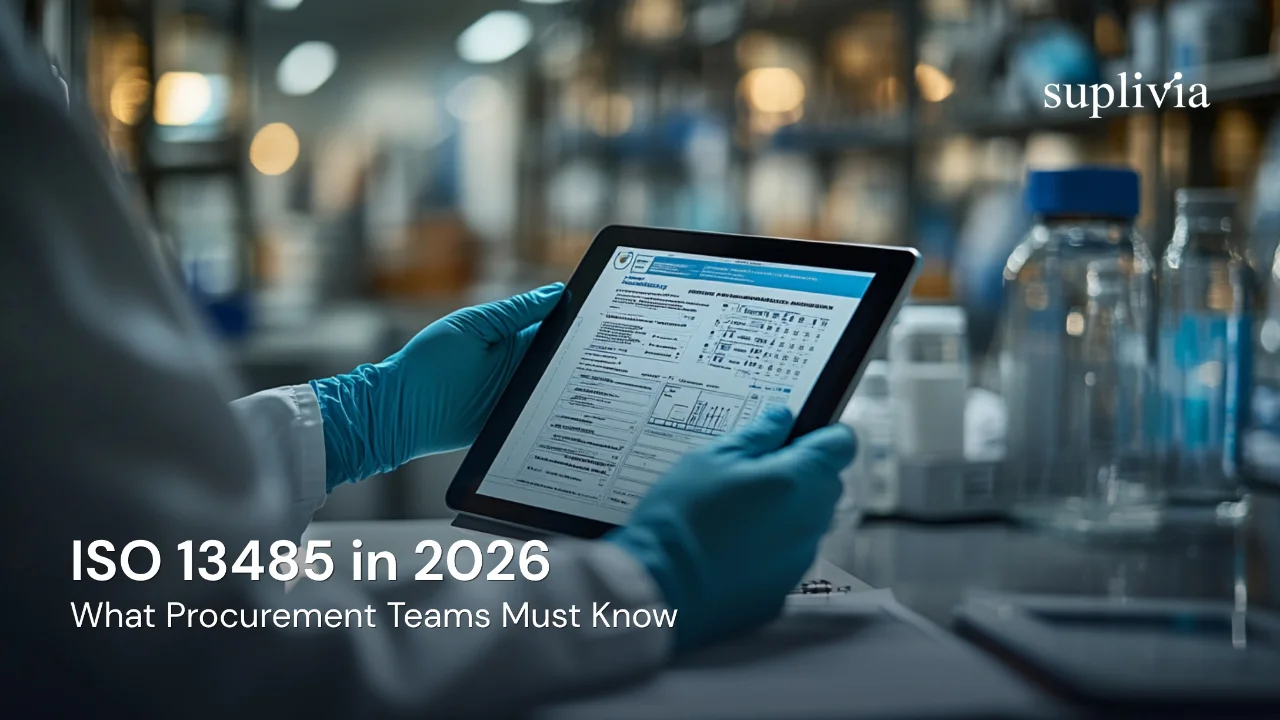
ISO 13485 has always been a quality signal. In 2026, it has become a market access requirement. With the FDA's new Quality Management System Regulation (QMSR) taking effect on 2 February 2026 and EU MDR enforcement continuing to tighten, procurement managers who treat ISO 13485 as optional due diligence are exposing their supply chains to serious risk.
Why ISO 13485 Matters More Than Ever in 2026
The biggest regulatory shift of the year is the FDA's QMSR, which formally incorporates ISO 13485:2016 by reference, replacing the older Quality System Regulation (QSR) under 21 CFR Part 820. This means manufacturers selling into the US market must now operate under a framework directly aligned with the international standard (FDA, February 2026). For procurement teams sourcing globally, this closes the historic gap between US and EU supplier requirements.
In the EU, ISO 13485 remains integral to demonstrating conformity under MDR 2017/745. Notified Bodies continue to require it as evidence of a functioning quality management system before CE marking can be granted or renewed. The standard is under scheduled review by ISO in 2026, with anticipated updates to align with the new ISO Harmonized Structure (URM Consulting, 2025).
The result: a single quality benchmark — ISO 13485:2016 — is now the effective baseline across the US, EU, UK, and Canada. Buyers sourcing from any of these markets, or supplying into them, cannot work around it.
20,000+
ISO 13485 certificates issued globally — and the number continues to grow as QMSR and MDR enforcement expand (ISO, 2019)
What Procurement Managers Should Verify
Holding a certificate is not the same as being compliant. Buyers need to go beyond checking the ISO 13485 box and assess what the certification actually covers.
- Scope of certification: An ISO 13485 certificate always specifies what is covered — design, manufacturing, distribution, or a combination. A manufacturer certified only for distribution is not covered for design or production. Confirm the scope matches the products you are sourcing.
- Certificate validity: Certificates are issued by accredited certification bodies and must be renewed through surveillance audits. Always request the current certificate with expiry date and issuing body. Expired certificates are common and easy to miss.
- Issuing body accreditation: Not all certification bodies carry equal weight. Verify that the issuing body is accredited by a recognised national accreditation authority (e.g., DAkkS in Germany, UKAS in the UK, or equivalent). Certificates from non-accredited bodies may not satisfy regulatory requirements.
- MDSAP recognition: The Medical Device Single Audit Program (MDSAP) covers ISO 13485 alongside FDA QMSR, Health Canada, and other regulators in a single audit. Suppliers with MDSAP certification carry the strongest multi-market compliance credential available.
- Supplier subcontracting: ISO 13485 requires manufacturers to control the quality of subcontracted processes. Ask whether critical components or sub-assemblies are produced in-house or outsourced, and whether those suppliers are also ISO 13485 certified.
Practical Steps for Your Sourcing Process
Building ISO 13485 verification into your standard supplier qualification process does not require additional auditing in most cases. The following steps can be applied immediately.
- Add an ISO 13485 certificate request to your supplier onboarding checklist, specifying scope, issue date, expiry date, and certifying body name.
- Cross-reference the certificate against the certifying body's public registry, where available, to confirm authenticity.
- For high-value or critical suppliers, request the most recent internal audit summary or CAPA log — ISO 13485 requires these to be maintained, and willingness to share them signals a mature quality culture.
- Where MDSAP certification is held, request the most recent audit report. This replaces multiple separate regulatory checks.
- Reassess certification status annually as part of supplier performance reviews, not only at onboarding.
ISO 13485 certification is no longer optional — it is the foundation of market access across the US, EU, UK, Canada, and other major markets. For procurement teams, it is the first filter, not the last. (PCBCart, April 2026)
The convergence of QMSR and MDR requirements in 2026 makes ISO 13485 the single most reliable compliance signal in global medical device sourcing. Procurement managers who verify scope, validity, and issuing body accreditation — rather than simply confirming a certificate exists — will significantly reduce regulatory and supply chain risk. Manufacturers listed on Suplivia are required to submit certification documentation as part of the verification process, making it straightforward to confirm ISO 13485 status before initiating contact.